
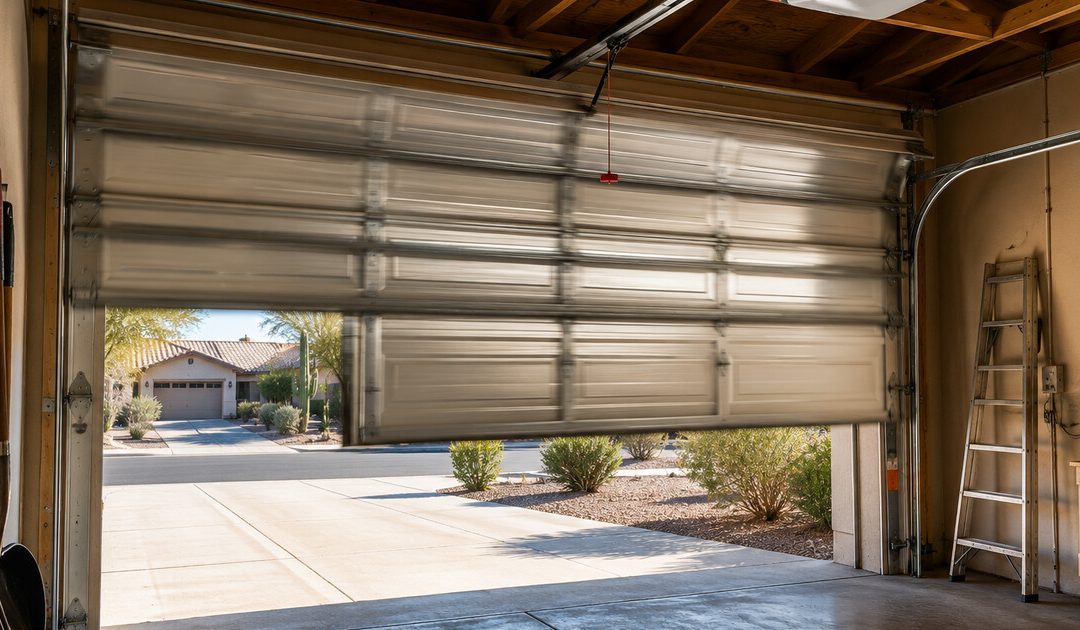
Every garage door makes some noise. The question is whether the noise changed, because a new sound almost always means a specific part is wearing, loosening or failing.
Here is how to read what you are hearing.
Squeaking and squealing
Usually: dry rollers, hinges or bearings.
The most common and least serious noise. In Tucson it shows up faster than elsewhere because heat thins lubricant and desert dust scours it away. A garage door lubricant on hinges, rollers, bearings and springs solves most cases. Avoid WD-40 — it is a solvent and will strip what lubricant is left.
If it comes back within weeks, the rollers are likely worn past the point lubricant helps.
Grinding
Usually: worn rollers, debris in the track, or a failing opener gear.
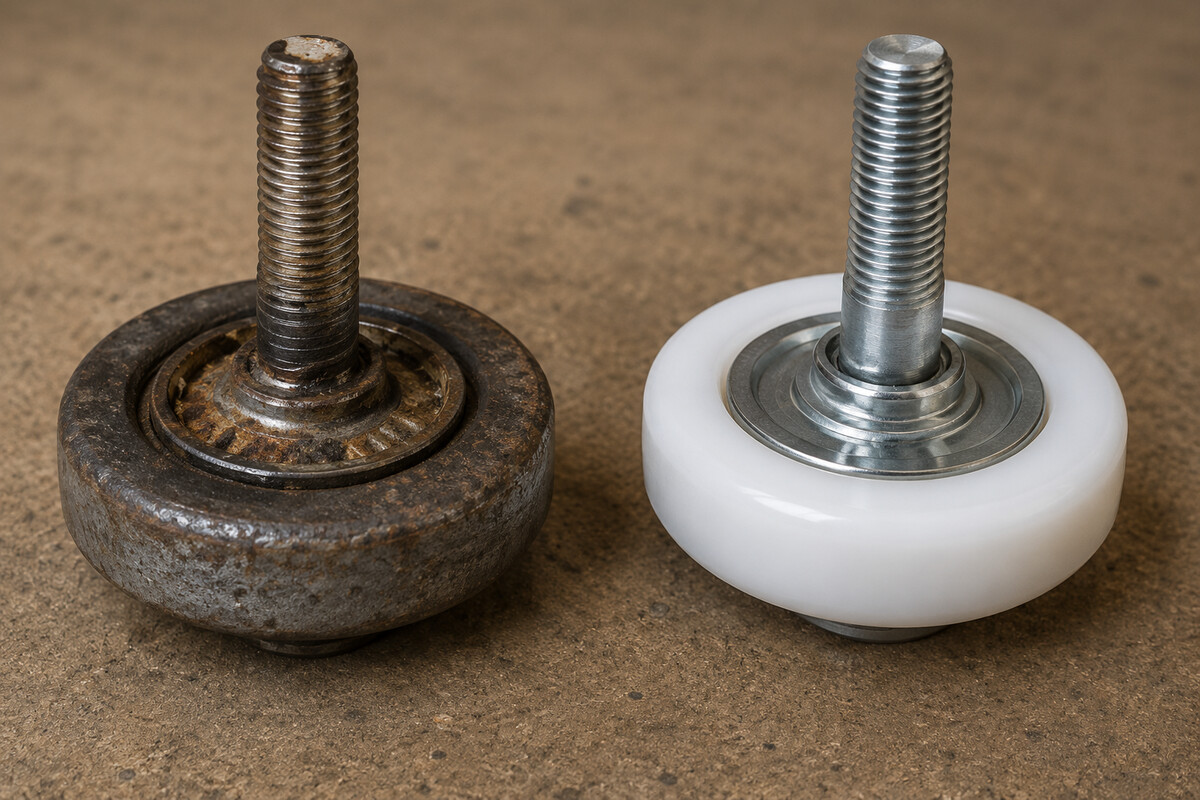
Grinding means metal contacting something it should not. Check the tracks for grit and dents, and watch the rollers as the door moves. A roller that wobbles or slides rather than rolls needs replacing.
If the grinding comes from the opener unit itself rather than the door, it is often a stripped drive gear — common on older chain-drive openers.
Rattling and vibrating
Usually: loose hardware.
Hundreds of cycles a year plus daily thermal expansion works bolts loose. Rattling is usually nuts and bolts on hinges, brackets and the track. Tightening the visible hardware often fixes it entirely. Do not touch anything attached to springs or cables.
A rattling opener chain or a loose rail can also be the source.
Popping and banging during travel
Usually: a torsion spring binding, or panels flexing.
A pop as the door starts moving often means the spring coils are dry and sticking as they wind. Lubrication helps. Popping partway through travel can be a panel or hinge flexing, sometimes because a hinge has cracked.
This one deserves attention rather than tolerance.
A single loud bang, then nothing works
Almost certainly: a broken spring.
This is not a maintenance issue. It is a failure, and often people hear it overnight as temperatures drop. Stop using the door and stop using the opener, since running it against a broken spring damages the motor. See broken spring repair.
Scraping
Usually: the door contacting the track or frame because something is out of alignment.
Scraping means the door is not travelling where it should. That can be a bent track, a loose track bracket or a door beginning to come off track. Worth catching early — see off-track repair.
Straining or humming with little movement
Usually: the opener struggling against an unbalanced door, or a capacitor problem.
If the motor runs but the door barely moves, the springs are likely out of balance and the opener is trying to do work it was never designed to do. Continuing will kill the opener.
The quick triage
- Squeaks and light rattles: lubricate and tighten. Genuinely DIY.
- Grinding, scraping, repeated popping: get it inspected before it becomes a bigger repair.
- A bang, a crooked door, or a door that will not lift: stop using it and call.
Why noise matters beyond annoyance
Almost every noise is friction, and friction is wear. A dry roller wears the track. A loose bracket lets the door travel slightly wrong, which loads the cables unevenly. Small noises left alone become the repairs that strand your car in the garage on a July afternoon.
Get it quiet again
If lubricating and tightening did not fix it, our noisy door service finds the actual source, and a full tune-up handles balance and opener settings at the same time.
Call 520-222-8817 and describe the sound — it usually tells us what we are walking into.